Thursday, 12 March 2015

Release Galician Patriot JN Heitor Now says the Yr Aflonyddwch Mawr


An independence activist Galician, JN Heitor, was arrested March 11 at Porto Airport in Portugal in the company of a man of Venezuelan nationality. They prepared both to board a plane to Venezuela.
 
JN Heitor was sentenced to 11 years in prison by the Spanish justice for his alleged participation in the illegal actions of the group "Resistencia Galega", it should be noted that this conviction is based on the unique secrets of a repentant who collaborated with the anti-terrorism court in Madrid to negotiate a pardon.
 
The sentence of 11 years is justified by its alleged participation in an attack against the antennas of radio and television in Galicia in 2012, which had only property damage.
 
It was in December, the date of his conviction, on the run.
 
At the time of writing the Venezuelan citizen has been released without charge and JN Heitor indicted by the Portuguese justice falsification of identity documents.
 
It should be handed over to the Spanish authorities in the framework of a European arrest warrant.
 
The organization that organizes antirépressif CEIVAR solidarity with the Galician independence activists imprisoned (6 are held to date) called for solidarity rallies with JN Heitor in several towns in Galicia.
 
Furthermore election platform NOS-UP of the radical nationalist left has affirmed its political solidarity with the arrested dubbed Koala.
 
As the youth organization BRIGA and platform for families and friends of political prisoners Galician What Voltem para a Casa .
 
Bretagne Info from CEIVAR (12 March 2015)


Crown Estates : The Land Question in Scotland


Yr Aflonyddwch Mawr welcomes the fact that Land Reform has now become a hot issue in Scotland.

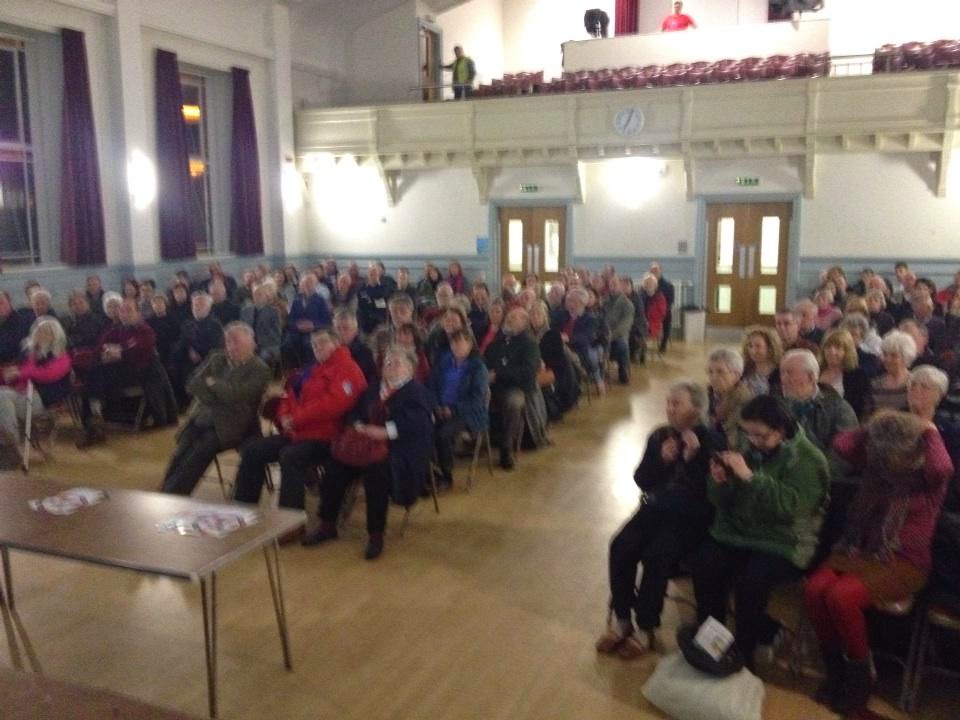
Over 200 people turned up in Kirriemuir to hear leading land rights  expert Andy Wightman give a talk on the Land Question.

The question of the Crown Estates is a major subject of interest to the people of Wales and Scotland but as the report below shows be prepared for subterfuge and backtracking by the British State.


UK MINISTERS were accused last night of abandoning key guidelines from the Smith Commission over devolving Crown Estate lands.

The criticism came after it emerged during a session of Holyrood’s devolution committee yesterday that after the assets are devolved the Crown Estate would be able to make new investments with profits from them heading to the Treasury.

SNP MSP Linda Fabiani, who is a member of the committee and represented the SNP on the Smith Commission, said the move ran contrary to her understanding of what was discussed at the Smith Commission.

“This represents nothing less than an abandonment of the Smith Commission agreement by the UK Government,” she said.

“Despite what was agreed by all the parties in the Smith Commission, the Westminster government has unilaterally decided that the UK Crown Estate should be able to continue to buy up land and assets in Scotland – with all the revenue flowing to the Treasury in London.

“In effect, the UK Government’s plans would mean there are two Crown Estates operating in Scotland at the same time – it’s completely unsustainable.

“The UK Government simply can’t get away with this ludicrous plan, which goes entirely against the spirit of the Smith Commission proposals.

“They must listen to the experts and ensure that full responsibility for the Crown Estate and its assets are in Scotland’s hands.”

The revelation followed an earlier attack on the process of transferring powers over the Crown Estate to Holyrood by leading land rights’ expert Andy Wightman.

Giving evidence to MSPs he said the proposals set out in the UK Command Paper made the transfer process too complicated.

“I welcome the Smith Commission recommendations but I do not think as currently drafted the Command Paper does in fact implement the intent of the Smith Commission,” he said.

“It has the potential of frustrating the fairly simple task, in my view, of devolving the administration of the management of these rights in what should be a straightforward matter.

“In the way it’s been drafted this scheme could end up in the quagmire.” He added that the process should be a straightforward matter requiring sections of the Scotland Act to be repealed.

But the UK Government had proposed a complicated scheme to proceed with the reforms which he believed were “wholly unnecessary”.

The original recommendation of the Smith Commission was for responsibility for the administration and management of the Crown Estate up to 200 miles from the shore to be devolved to Scotland – but the UK Government’s Command Paper instead proposes a “scheme” for devolution of powers over the Crown Estate.

“As matters stand in the Command Paper, this is a recipe for confusion, conflict and chaos,” he added.

The Smith Commission recommended that Scotland got control of all Crown Estate land and assets. It would mean that all money coming in through rents from rural estates, mineral and salmon fishing rights, about half of the coastal foreshore, almost all of the seabed, as well as ports and offshore renewable energy, would come under the control of the Scottish Parliament.

During the committee hearing the boss of an offshore wind energy company said that it was in the interests of businesses aiming to develop green energy to have a simplified system of land ownership and control in place as it would make their work easier.

“We are one of the largest wind energy developers in the world. We choose to come to the UK to develop offshore wind because of the scale of the market,” said Dan Finch EDPR managing director.
“We chose to set up our base in Scotland because of the support of the Scottish Government, in particular, for wind energy.

“One of the problems we have is that while we broadly agree with the proposals, there are also powers that are retained with the UK Government, which would not facilitate the development of wind energy in Scotland.

“We need access to the market as a whole.”

A spokeswoman for the Scotland Office said: “The draft clauses published on 22 January transfer responsibility for the Crown Estate to the Scottish Government.

“There are several reasons for this: because assets and liabilities will be transferred they need to be properly identified; the rights of Crown Estate staff need to be protected; as do interests of defence and national security.

“Discussions are under way between the Governments to determine these matters.”


SOURCE:  http://www.thenational.scot/news/uk-accused-of-bid-to-keep-crown-estate.819

What is a Free Nation ? by James Connolly


First published in Workers' Republic, 12 February 1916
Transcribed by the James Connolly Society - IRSM/IRSP
Formatted and indexed by Workers' Web ASCII Pamphlet project


We are moved to ask this question because of the extraordinary confusion of thought upon the subject which prevails in this country, due principally to the pernicious and misleading newspaper garbage upon which the Irish public has been fed for the past twenty-five years.

Our Irish daily newspapers have done all that human agencies could do to confuse the public mind upon the question of what the essentials of a free nation are, what a free nation must be, and what a nation cannot submit to lose without losing its title to be free. It is because of this extraordinary newspaper-created ignorance that we find so many people enlisting in the British army under the belief that Ireland has at long last attained to the status of a free nation, and that therefore the relations between Ireland and England have at last been placed upon the satisfactory basis of freedom. Ireland and England, they have been told, are now sister nations, joined in the bond of Empire, but each enjoying equal liberties - the equal liberties of nations equally free. How many recruits this idea sent into the British army in the first flush of the war it would be difficult to estimate, but they were assuredly numbered by the thousand.

The Irish Parliamentary Party, which at every stage of the Home Rule game has been outwitted and bulldozed by Carson and the Unionists, which had surrendered every point and yielded every advantage to the skilful campaign of the aristocratic Orange military clique in times of peace, behaved in equally as cowardly and treacherous a manner in the crisis of war.

There are few men in whom the blast of the bugles of war do not arouse the fighting instinct, do not excite to some chivalrous impulses if only for a moment. But the Irish Parliamentary Party must be reckoned amongst that few. In them the bugles of war only awakened the impulse to sell the bodies of their countrymen as cannon fodder in exchange for the gracious smiles of the rulers of England. In them the call of war sounded only as a call to emulate in prostitution. They heard the call of war - and set out to prove that the nationalists of Ireland were more slavish than the Orangemen of Ireland, would more readily kill and be killed at the bidding of an Empire that despised them both.

The Orangemen had at least the satisfaction that they were called upon to fight abroad in order to save an Empire they had been prepared to fight to retain unaltered at home; but the nationalists were called upon to fight abroad to save an Empire whose rulers in their most generous moments had refused to grant their country the essentials of freedom in nationhood.

Fighting abroad the Orangeman knows that he fights to preserve the power of the aristocratic rulers whom he followed at home; fighting abroad the nationalist soldier is fighting to maintain unimpaired the power of those who conspired to shoot him down at home when he asked for a small instalment of freedom.

The Orangeman says: "We will fight for the Empire abroad if its rulers will promise not to force us to submit to Home Rule." And the rulers say heartily: "It is unthinkable that we should coerce Ulster for any such purpose."

The Irish Parliamentary Party and its press said: "We will prove ourselves fit to be in the British Empire by fighting for it, in the hopes that after the war is over we will get Home Rule." And the rulers of the British Empire say: "Well, you know what we have promised Carson, but send out the Irish rabble to fight for us, and we will, ahem, consider your application after the war." Whereat, all the Parliamentary leaders and their press call the world to witness that they have won a wonderful victory!

James Fintan Lalor spoke and conceived of Ireland as a "discrowned queen, taking back her own with an armed hand". Our Parliamentarians treat Ireland, their country, as an old prostitute selling her soul for the promise of favours to come, and in the spirit of that conception of their country they are conducting their political campaign.

That they should be able to do so with even the partial success that for a while attended their apostasy was possible only because so few in Ireland really understood the answer to the question that stands at the head of this article.

What is a free nation? A free nation is one which possesses absolute control over all its own internal resources and powers, and which has no restriction upon its intercourse with all other nations similarly circumstanced except the restrictions placed upon it by nature. Is that the case of Ireland? If the Home Rule Bill were in operation would that be the case of Ireland? To both questions the answer is: no, most emphatically, NO!

A free nation must have complete control over its own harbours, to open them or close them at will, or shut out any commodity, or allow it to enter in, just as it seemed best to suit the well-being of its own people, and in obedience to their wishes, and entirely free of the interference of any other nation, and in complete disregard of the wishes of any other nation. Short of that power no nation possesses the first essentials of freedom.

Does Ireland possess such control? No. Will the Home Rule Bill give such control over Irish harbours in Ireland? It will not. Ireland must open its harbours when it suits the interests of another nation, England, and must shut its harbours when it suits the interests of another nation, England; and the Home Rule Bill pledges Ireland to accept this loss of national control for ever.

How would you like to live in a house if the keys of all the doors of that house were in the pockets of a rival of yours who had often robbed you in the past? Would you be satisfied if he told you that he and you were going to be friends for ever more, but insisted upon you signing an agreement to leave him control of all your doors, and custody of all your keys? This is the condition of Ireland today, and will be the condition of Ireland under Redmond and Devlin's precious Home Rule Bill.

That is worth dying for in Flanders, the Balkans, Egypt or India, is it not?

A free nation must have full power to nurse industries to health, either by government encouragement or by government prohibition of the sale of goods of foreign rivals. It may be foolish to do either, but a nation is not free unless it has that power, as all free nations in the world have today. Ireland has no such power, will have no such power under Home Rule. The nourishing of industries in Ireland hurts capitalists in England, therefore this power is expressly withheld from Ireland.

A free nation must have full power to alter, amend, or abolish or modify the laws under which the property of its citizens is held in obedience to the demand of its own citizens for any such alteration, amendment, abolition, or modification. Every free nation has that power; Ireland does not have it, and is not allowed it by the Home Rule Bill.

It is recognized today that it is upon the wise treatment of economic power and resources, and upon the wise ordering of social activities that the future of nations depends. That nation will be the richest and happiest which has the foresight to marshal the most carefully its natural resources to national ends. But Ireland is denied this power, and will be denied it under Home Rule. Ireland's rich natural resources, and the kindly genius of its children, are not to be allowed to combine for the satisfaction of Irish wants, save in so far as their combination can operate on lines approved of by the rulers of England.

Her postal service, her telegraphs, her wireless, her customs and excise, her coinage, her fighting forces, her relations with other nations, her merchant commerce, her property relations, her national activities, her legislative sovereignty - all the things that are essential to a nation's freedom are denied to Ireland now, and are denied to her under the provisions of the Home Rule Bill. And Irish soldiers in the English Army are fighting in Flanders to win for Belgium, we are told, all those things which the British Empire, now as in the past, denies to Ireland.

There is not a Belgian patriot who would not prefer to see his country devastated by war a hundred times rather than accept as a settlement for Belgium what Redmond and Devlin have accepted for Ireland. Have we Irish been fashioned in meaner clay than the Belgians?

There is not a pacifist in England who would wish to end the war without Belgium being restored to full possession of all those national rights and powers which Ireland does not possess, and which the Home Rule Bill denies to her. But these same pacifists never mention Ireland when discussing or suggesting terms of settlement. Why should they? Belgium is fighting for her independence, but Irishmen are fighting for the Empire that denies Ireland every right that Belgians think worth fighting for.

And yet Belgium as a nation is, so to speak, but a creation of yesterday - an artificial product of the schemes of statesmen. Whereas, the frontiers of Ireland, the ineffaceable marks of the separate existence of Ireland, are as old as Europe itself, the handiwork of the Almighty, not of politicians. And as the marks of Ireland's separate nationality were not made by politicians so they cannot be unmade by them.

As the separate individual is to the family, so the separate nation is to humanity. The perfect family is that which best draws out the inner powers of the individual, the most perfect world is that in which the separate existence of nations is held most sacred. There can be no perfect Europe in which Ireland is denied even the least of its national rights; there can be no worthy Ireland whose children brook tamely such denial. If such denial has been accepted by soulless slaves of politicians then it must be repudiated by Irish men and women whose souls are still their own.

The peaceful progress of the future requires the possession by Ireland of all the national rights now denied to her. Only in such possession can the workers of Ireland see stability and security for the fruits of their toil and organization. A destiny not of our fashioning has chosen this generation as the one called upon for the supreme act of self-sacrifice - to die if need be that our race might live in freedom.

Are we worthy of the choice? Only by our response to the call can that question be answered.

Wednesday, 11 March 2015

Learning the lessons of history : Socialism in Ireland (1908) by James Connolly

We at Yr Aflonyddwch Mawr publish the following article by James Connolly on the importance of the Land Acts in Ireland in its struggle for national and social liberation.
 
It follows on from the St David's Day Statement of the strategic importance of the Land Question in Wales for National and Social Liberation.
 
James Connolly continually combated the Irish Home Rulers, upholding against the idea of Home Rule, the idea of an Irish Workers Republic. For James Connolly the Home Rulers would only facilitate  governmentalism degenerating into despotic paternalism.

Liam Mellows offered the same critique as James Connolly when he saw the Home Rulers transmute into the Irish Free State and said it was  a buffer erected between British Capitalism  and the Irish Republic.
 
A Workers Republic can only be erected on the ruins of the Irish Free State Liam Mellows correctly surmised.
 
We should remember that in 2016 as we recall 1916.


Therefore when the Plaid Cymru  backed - Yes Campaign in Wales issued the call for Home Rule expressing the desire for Wales not to left behind - we wondered what had happened to the lessons of history.
 
As Marx said the tradition of all dead generations weighs like a nightmare on the brains of the living.

It is a nightmare, it is the thinking of Plaid Cymru in the 21st Century repackaging the shoddy goods of the Home Rulers has something "new" terrified of calling for a Welsh Socialist Republic which would strike chord with the working class in Labour strongholds - terrified of calling for real Independence and striking a chord with its nationalist base and beyond.

Plaid Cymru defends the indefensible European Union has it demonstrates its brutal vindictiveness against the national and social rights of the Greek people - with the terrifying consequence of allowing the British Nationalist - United Kingdom Independence Party to ravage the Welsh heartlands rather then being kept the other side of Offa's Dyke.
 
Marx was right a nightmare weighing on the brains of the living.


From The Harp, March, 1908 and Forward, August 16, 1913, respectively.
Transcribed by The James Connolly Society in 1997.

I

We find that amongst a large section of the Irish in this country (the U.S.A.) and Irish Socialists here are included, it is tacitly assumed that Socialism cannot take root in Ireland, that the Home Rule press, the supposed conservative habits of thought of the people and, above all, the hostility of the clergy, make it impossible for Socialist thought to make headway amongst the Irish working class.
 
This assumption is, of course, not to be reasoned with – you cannot reason with a thing that ignores facts – but is only to be combatted with a quiet presentation of facts to prove that which is assumed as impossible of existence, is already existent, and not only existent, but lusty, aggressive and powerful.

The influence of the Home Rule Press is in reality nil amongst the intelligent working-class of Ireland: the conservative habits of thought supposed to be characteristically Irish are in reality the reflex of agricultural conditions in Ireland, as elsewhere, and do not prevail where the Irish worker lives and suffers in the industrial environment of a city and the hostility of the clergy has worn off its own edge by too frequent and indiscriminate use.
 
The Irish Socialist Republican Party – founded in May 1896, in Dublin, and now represented by the Socialist Party of Ireland – has had to suffer under the boycott of the entire Irish press, with the single honourable exception of the United Irishman, in the early days of that journal (now rechristened, Sinn Fein).

Of the weekly newspapers was this more particularly true, and it is from the weekly Irish newspapers that the Irish in America and the agricultural Irish, derived and derive their impressions of political life in Ireland.

Yet, despite this attempt to destroy the influence of this working-class party and to circumscribe the scope of its activities, it has to its record and to its honour, the credit of having initiated and carried to a successful conclusion – unaided – the most striking protest against British tyranny in Ireland in this generation, viz., the Anti-Jubilee Protest of Dublin in 1897, of having been the moving spirit in rendering nugatory the visit of the late Queen Victoria on a recruiting mission to Dublin during the Boer War (a fact recorded by the French newspapers of the time, which spoke of the Socialist Republicans as the only centre from which the British authorities expected trouble) of having originated and popularised an anti-enlisting crusade at a time when even some well-intentioned ‘physical-force men’ favoured the idea of Irish youths entering the British army, “in order to learn the use of the rifle” – one of the most disastrous ideas ever current in Ireland; of having emphasised the fact that there have ever been two currents in modern Irish history, viz., the revolutionary and the compromising or constitutional, and that their ideas can no more mix or their ideals be compounded, than may blend oil and water, and finally, of having conducted the first political campaigns of the Irish working-class on the basis of revolutionary Socialism.

Let those who tell us that the Irish will never respond to the call of Socialism remember that five years ago the candidate of the Irish Socialist Republican Party, in contests against the nominees of the Home Rule and Unionist Parties, polled a vote which represented a third of the total electorate; let them remember this, and then, thinking of the frantic joy of the Socialist Parties of America when they succeed in polling the necessary three or five per cent to get on the official ballot let them stop trying to discourage the Irish in America by their foolish declarations that Socialism will never take root amongst the Irish.

Socialism in Ireland is now a force, influencing alike the political, economic and literary thought of the island.

II

It is interesting to observe how Ireland has been and is being made the scene of many radical experiments in legislation which, in any other country, would be only looked for as the result of a great Socialist upheaval.
 
The Land Acts or rather the Purchase Clauses of the Land Acts upon which so many of our doctrinaires waste so much good ink in reckless denunciations are, despite their many drawbacks, an assertion of the right of the original community not only to establish new property relations to suit new ideas, but also to establish tribunals by means of which the working of these relations may be supervised and controlled.

Of course it is not the Land Nationalisation many of us would like to see, but it is nevertheless the germ out of which a socialisation of the land may ultimately develop.

In Ireland the propaganda of Land Nationalisation was doomed to sterility in the past by virtue of the fact that the most earnestly radical and truly revolutionary people in the country, and hence the people most sincerely democratic, looked upon the government as a foreign government and, therefore, upon the proposal to nationlise the land as a proposal to hand over the soil of their country to a foreign government and thus to increase the powers of that government over the economic as well as over the political life of the Irish.

In their phraseology, Land Nationalisation meant making the land the property of the government, and they would inquire:
“What government? The English Government! We have no other government here. Oh, no! It is too much power that government has already.”
Hence, not even Michael Davitt could popularise Land Nationalisation in Ireland in his day.

The political groundwork was wanting, the necessary basis of a government directly under the control of the people concerned.

With the Nationalist masses the same difficulty was encountered in the propagation of Socialism, until the uncompromising attitude of the Dublin Socialists on the national question made it clear that Socialism meant on the political side of Ireland an absolute revolutionary change which would make the people of Ireland complete rulers of their own country, as the economic change would thus logically make them owners of the country they would politically rule.
 
In other words, the Socialists of Ireland had to recognise that the world for the workers can only be realised by the people of each country seizing upon their own country and wresting it by one means or another from the hands of the present rulers or proprietors and restoring it with all its powers and potentialities to the people who inhabit it and labour upon it.

With the advent of self-government in any shape in Ireland, the question of the ownership and administration of the soil can, and will, be approached in a new spirit.

One change I foresee, and hope for, exists already in embryo in the labourers’ cottages Acts. Under these Acts, the local authority has the power to acquire land and build cottages for the labourers. These latter become the tenants of the local authority.

Now, I foresee that there may be a change in the spirit of future Land Acts, and that the local County Councils may be authorised to acquire the lands now being purchased by the farmer, and that the purchase price being paid by the present tenants may be changed into a rent payable to the democratically elected County Councils.

If this were done and a reduction in the yearly payment, coupled with a guarantee of fixity of tenancy and right to a selling interest in the farm (goodwill) given to the farmers in return for their surrender of their future rights of ownership, it is quite conceivable that such a change might be effected without any more opposition than would be offered to any other legislative change.

But the result of this change would be that the local County Councils would become the owners of the soil under the national government, that all questions affecting the administration of the soil would be as keenly under the supervision of the democracy immediately interested as questions affecting the occupancy of labourers’ cottages are now, and that thus the gradual democratisation of the agriculture interests would become the vital question in rural politics, as the spread of the same political principle and method of administration would similarly affect industrial interests in urban and national politics.

The squabbles over the occupancy of a labourer’s cottage which, at present, make such piquant reading in our Irish newspapers have a sordid side, but this that I have glanced at shows that they have a practical, illuminating side also.

When the principal deliberations of an Urban or County Council perforce turn on the question of the administration of the farms and other lands of the County, as the deliberations of Boards of Guardians now turn upon the occupancy of labourers’ cottages, we will begin to have a vivid understanding of the Marxian phrase about “the government of men being replaced by the administration of things.”

The Land Acts dispossessed the landlords and thus ended the economic influence upon which their political power is based. Hence, outside of North-East Ulster, the landed aristocracy have ceased to be a power in politics. An agricultural labourer would have a greater chance to be elected than a landlord in the south-west or east of Ireland would have by his former tenants.

The genius of peasant proprietorship is essentially individualistic, and therefore exercises a disintegrating influence upon the political strength and influence of the peasant proprietor.

The Land Acts, therefore, have, despite their faults, destroyed the slavery of the Irish tenantry, taken from agricultural questions their exclusive power over Irish affairs, and opened a way for the fundamental reorganisation of the social life of the community.

Then, two years ago, another Royal Commission investigating the question of Irish railways, reported in favour of Nationalisation.

With the coming of self-government the almost unanimous expression of approval with which this was received in Ireland is likely to take concrete form in an legislative enactment.

And now another Commission reports, likewise, in favour of a State Medical Service. And this, also, is received with a chorus of approval.

Said I not that although the Irish have little regard for Socialist theories they have a strong bias in favour of action on lines that are in essence lines of Socialist activity?

Side by side with all this development of mere Government Socialism, those who know Ireland best know that there is also developing that strong and active spirit of industrial rebellion, that aggressive challenging of the rights and powers of the master class that is absolutely necessary to prevent such governmentalism degenerating into despotic paternalism.

I do not believe it to be possible to prevent a continual extension of the powers of government, even if it were desirable, but I look to the cultivation of the rebel spirit to secure that that extension of the functions of government shall connote a conquest of powers by the working-class instead of an invasion of our rights by the master class.

It is because of that defiant, rebel spirit in Ireland today, ever keeping step with, indeed outmarching, the trend of legislative experimenting with social problems that we Irish Socialists feel at last that we are leaving the stage of theorising and are seeing our principles becoming the faith that moves our class to action.

It is an inspiration to know the working-class of Ireland in their times of conflict. To see that class resolute, erect, defiant, day by day battling with its Nationalist masters, and in starvation and suffering winning its way to victory, which, at the same time as it closes in grappling with the Irish exploiter, it holds itself uncompromisingly aloof from and hostile to its British rulers and their Irish allies. To know that class is to love it.

And I pity those in whom the narrow prejudices of a colony are still, after 300 years of plantation, too strong to permit them to identify themselves with such a nation.

Saturday, 28 February 2015

The Land of My Fathers Reclaimed by Nickglais


Yr Aflonyddwch Mawr are re-publishing this article of Nickglais for St David's Day.

Between  1893 and 1894 Post Offices throughout Wales carried notices of a Royal Commission on Land in Wales and Monmouthshire, inviting people to attend public meetings with the purpose of taking evidence about the problems of Land tenure in Wales.

In all, Wales was to witness eighty such meetings with an additional nineteen meetings in London making for a total of ninety nine meetings to take evidence of tenants, landlords, the churches and other interested organisations.

The background to the Royal Commission was the activity of the Welsh Land League and Cymru Fydd and Gladstone's discussion of Home Rule all Around for Wales, Scotland and Ireland.

New disturbances erupted in the 1880s in Wales caused by tenant farmers and labourers being charged high rents by the landowners. The Welsh Land League that resulted in 1886 from this crisis approached the Welsh Land problem in a throughly constitutional way.

Whilst the problem of Land Tenure was central to the Royal Commission, there was also a tithe question in Wales where tenants were forced to pay tithes to the Anglican Church of Wales even if they were Non Conformists. The Welsh Land League was also active concerning the tithe problem and the issue was not finally resolved by legislation until the 1920's.

Whereas Ireland was to see a series of Land Acts effectively turning 10,000 large estates into 400,000 Irish owned farms overturning the Landlord tenant relationship.

The Royal Commission on Land for Wales and Monmouthshire concluded that the landord tenant relationship was the most "appropriate" for the Welsh.

The Royal Commission Report was a victory for the Landlords who were seen a "benevolent", despite mountains of evidence to the contrary.

There was to be no buying out of the Landlords like in Ireland, but the Commission concluded that if some Welsh tenants were alreading buying their land then maybe assistance should be provided, however it was only retrospective and was not a future policy to be endorsed by the Commission.

Historians have interpreted the differences in the final Royal Commission Report between a majority report and a minority report has being the reason for the abandonment of a Welsh Land Act.

While the minority report was full blown Landlordism the majority report while acknowledging problems with Land Agents, compensation for improvements etc was only a more watered down version of Landlordism that we would expect from Liberals rather than Tories.

The fact that nothing happened and the Welsh Land Act was dead by 1900 shows that the constitutional approach to these matters did not work.

Lloyd George was consciously or unconsciously being absorbed by the interests of the British State, despite his flirtation with the Boers and despite his rhetoric against landords he was well on his way to becoming a servant of the British State.

Irish Land was going to be returned to the Irish people but Welsh Land was not going to be returned to the Welsh people.

One of the most deeply hidden secrets of the Victorian period was the massive expansion of Royal ownership of Land including Welsh Land enabled by an Act of 1862 which lifted restrictions on the Monarch's ownership of Land.

Since the Glorious Revolution and the placing of William of Orange on the throne through to the reign of William IV the monarchy was restricted by the rising bourgeoisie and landlords from owning more land has this was seen has a source of Royal social power and the bourgeoisie and the landlords wanted a tame symbolic monarchy.

Queen Victoria changed that, when she came to the throne, there were forty Lords owning more Land than her and she set about acquiring Land by any means necessary to restore the social power and prestige of the monarchy.

The Act of 1862 was a enabling mechanism for the monarchy to achieve real social power. A wide variety of vehicles were set in motion to achieve an  increase in Royal power, the Crown Estate, The Duchy of Cornwall and The Duchy of Lancaster.

I have estimated that Royal Lands from approximately 316,000 acres in Victorian Times approach 677,000 acres today. I would stress this is probably an underestimate has the Monarchy goes to great length's to hide it's extensive Land ownership including in Wales.

Needless to say the Monarchy has increased its Land ownership in Wales in the 20th Century.

Leaving aside the English Conquest of Wales in 1282 and The Tudor robbery of Welsh Lands one of the most invidious acts of expropriation of Welsh Land occurred between 1795 and 1874 aided and abetted by Welsh Landlords and Gentry collaborators in the Tudor Taff tradition, the real English lickspitals in Wales.This was accumulation by dispossession of the Welsh people.

Between 1795 and 1874 some 1,696,827 acres of Welsh Land belonging to the common people out of a total Welsh acreage of 5,121,013 was enclosed, deprived of community land for survival people many were driven into the industrial valleys for work, survival for ordinary folk in the nineteenth century Wales on the land was extremely hard and it looked to some with the Royal Commssion on Land in Wales and Monmouthshire in 1893 and 1894 that  help was at hand.

However hopes were dashed and the Welsh were betrayed by their erstwhile petty bourgeoise leaders who where more interested in the British State than the state of Wales.

Of course Lloyd George never failed to employ anti Landlord rhetoric when it suited him, but Wales was not going to be like Ireland or France with a large independent farming class owning its own land, the British State had decided that.

Kevin Cahill has pointed out in  "Who Owns Britain"  Wales remains a country with a small percentage of its people owning land. This of course also has implications for affordable housing has land is a key element in building new homes.

In 2012 the fallen banner of 1896 was picked up by Cymrwch Y Tir Yn Ol  and the struggle for a new Welsh Land Act is underway  and a campaign has been launched for the return of our stolen land and an electronic petition is circulating calling for the return of Royal and Aristocratic Lands in Wales to the people. Sign Here :

http://www.gopetition.com/petitions/land-act-for-wales.html


We are not calling for the redistribution of Welsh Land to Welsh tenant farmers like in Ireland but for the redistribution of Welsh Land to the people, the re-creation of Welsh common land that our fathers lost, like the one million acres lost between 1795 - 1874.

We support  new land vehicles like community Land Trusts, priority right to buy Land by Welsh communities similar to the Scottish Land Reform Act of 2003. Although the Scottish Land Reform Act is far to limited.

We should set ourselves the task of recovering one million acres of Welsh Land for the community land trusts and other community land owning vehicles over the coming  years.

The Great Unrest Group for a Welsh Socialist Republican Movement has set up a Welsh Land Commission for ongoing research into the Welsh Land Question and we appeal to you on St David's Day,our national day, to reclaim the Land of Our Fathers.

If the Land of your Fathers is dear to you it is time do something about it apart from singing - challenge people to sign the petition.


Sources:

The Royal Commission on Land in Wales and Monmouthshire 1896.

Who Owns Britain by Kevin Cahill

Ken Morgan - Modern Wales

Adfeddiant - Welsh Land Reform Now !


Today is St Davids Day our Welsh National Day and many people will be singing Hen Wlad Fy Nhadau (The Land Of My Fathers) written by Evan James of Pontypridd in 1856.

Today we should reflect on the words of the song and think about the question of Welsh Land; The Land of our Fathers and our Mothers.

Kevin Cahill has pointed out in "Who Owns Britain" Wales remains a country with a small percentage of its people owning land.

This of course also has implications for affordable housing has land is a key element in building new homes and economic regeneration.

Kevin Cahill is of the view that lack of Welsh Land Ownership contributes to structural poverty in Wales.

To understand why this situation came about we need to understand the history of Welsh Land.

Following the complete occupation of Wales by the Anglo Normans in 1282 - 4 and again, in the 1420's following the War of Independence led by the great Welsh Prince Owain Glyndwr, great areas of Welsh land was either taken by the English Crown or 'given' as rewards to English barons for fighting for England in the Welsh Wars.

Ironically this was repeated by the Tudors in the 16th, who were of 'Welsh Descent',One such example being the Dukes of Somerset being given Mynydd y Gwair and much else throughout Southern Wales.

This Mountain is now the centre of a major local issue and national campaign as the Somerset Trust intends to establish a Wind Mill Plantation on it.

Apart from the above, much of Welsh land was common land - which meant that the peasantry had the right to build a smallholding on it as well as hunt and fish but, increasingly over the centuries and up to the present, the Gentry and incoming 'New Conquistadores, such as Iron and Slate Masters began to seize this Common Land by means of Enclosure Acts.

The issue of Anglican Church ownership was very much addressed in the Welsh Tithe Wars of 1886 - 88 by a National Land League but there is still much unfinished business to be taken care of.

Today, the aforementioned land is still occupied by the English Crown and the descendents of the English barons and,increasingly, by outside 'Utility Companies as in the case of the Vyrnwy Estate, It is being extensively plundered of its natural resources, such as water and timber, and is being savagely destroyed by gigantic
windfarms.

Plans to start unconventional gas extraction will place whole areas of land and water under threat, when we should be cutting back on our use of fossil fuels.All of this is putting the many at risk, solely to enhance the profits of corporations.

It is our inherited Welsh land and we want it returned to the communities and people of Wales through a Wales Land Act.

We are not calling for the redistribution of Welsh Land to Welsh tenant farmers like in Ireland but for the redistribution of Welsh Land to the people, the re-creation of Welsh common land that our forebears lost, like the one million acres lost to enclosures between 1795 - 1874.
 
We support new land community Land Trusts, priority right to buy Land by Welsh communities similar to the Scottish Land Reform Act of 2003.

Although the Scottish Land Reform Act is far to limited.
 
We should set ourselves the task of recovering one million acres of Welsh Land for the community land trusts and other community land owning vehicles over the coming years and March 1st St Davids Day should be the day of Wales not just in song but in deed as we campaign for a Welsh Land Act.

In view of the fact that our Cymric land is being desecrated by rapacious landlords, hereditary aristocrats, the English Crown and Corporate Utility Companies we have organised a Petition that demands of the Westminster Parliament and the Welsh Government the restoration of the land, by compulsory purchase, to its rightful owner, the People of Cymru, in order to preserve our heritage, the great beauty of this land and the common right of our people to access and make use of it until perpetuity.
 
Visit Petition here :
Signed by :

Yr Aflonyddwch Mawr - The Great Unrest Group
 
Grŵp Gomiwnyddol Libertaraidd - Libertarian Communist Group
 
World To Win - Wales
 
Cymrwch Y Tir Yn Ol

Hawliau - Welsh National Rights Movement

Balchder Cymru


WE INVITE OTHER ORGANISATIONS TO SUPPORT OUR STATEMENT FOR WELSH LAND REFORM - IF YOU WISH TO ADD THE NAME OF YOUR ORGANISATION LEAVE US A MESSAGE OR E MAIL : adfeddiant@gmail.com


"Balchder Cymru supports the Great Unrests campaign for a new land reform act. Cymru should belong to the people of Cymru not to the Crown or the possession of a wealthy Barron , Lord etc. "

Adam Phillips

President Balchder Cymru

Monday, 16 February 2015

Tribute to John Davies - Welsh Historian - Video on Wales and Scotland and why Scotland should vote Yes to Independence


Welsh Historian, Dr John Davies, is guest speaker at the YES Offices to give an historical perspective on Welsh and Scottish politics and why Scotland should vote YES

Yr Aflonyddwch Mawr  since its formation in 2012 has devoted much of it s time to questions of Welsh History and appreciates John Davies' and his contribution to Welsh historical research.

Watching the video above reminds us of our loss - but we at Yr Aflonyddwch Mawr are more determined than ever to recover our Welsh History of Struggle - forward to a People's History of Wales.

This speech contains many intellectual and historical gems but John Davies's praise of Scotland has a model of a nationality based on a Civic rather than ethnic identity is a message we need to take to heart and head in Wales.